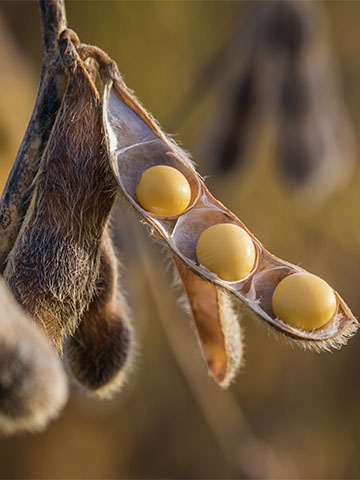


For soybean cultivation, nitrogen (N) is the nutrient required the most by the crop, due to the grains being very rich in protein and present on average 6.5% of this nutrient in its composition.
So, to produce 1,000 kilos of soybeans, a minimum of 65 kg of N is required. Moreover, at least 15 kg of N is required for the maintenance of leaves, stems and roots, totaling an average necessity of 80 kg of N to produce 1,000 kg of soybean.
In this sense, if we consider a production of 3,000 kg of beans, it is necessary 240 Kg of N, 195 Kg being only for the composition of the beans.
The use of nitrogen fertilizers is the fastest way to supply N to plants, so that this nutrient is quickly absorbed and assimilated, but this practice has a very high cost.
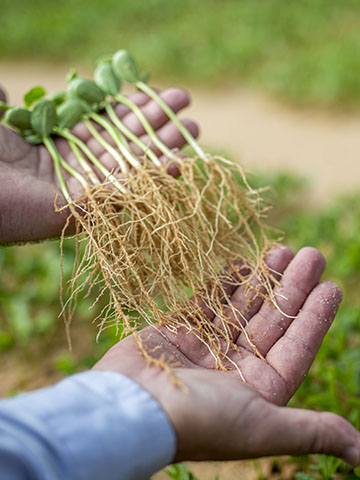
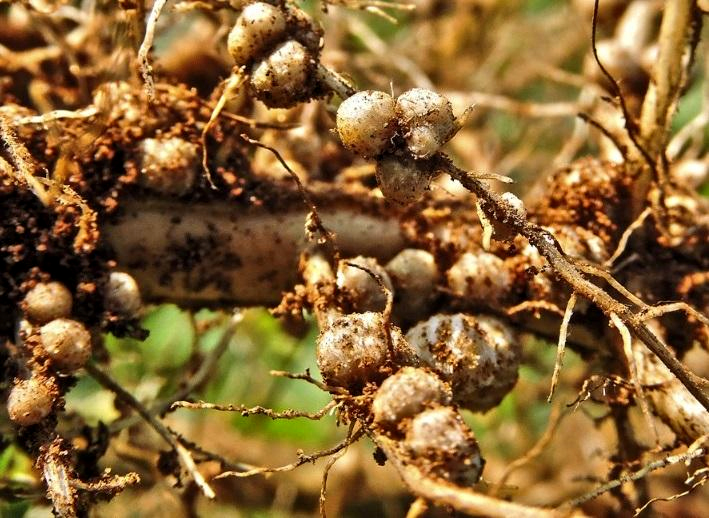
If this were the only way to supply the necessary nitrogen, soybean cultivation would be practically unfeasible due to its high production cost. However, there are other options for providing N to the plants effectively and at a lower cost, one being inoculation with bacteria of the genus Bradyrhizobium, which are associated with the soybean root system, establishing an important symbiosis that results in the supply of all nitrogen the plant needs.
With this in mind, the understanding of the entire physiological process involving bacteria, plants and nutrient fixation is of high importance for both researchers and farmers, as it is through this knowledge that management adequacy will be possible, aiming at greater efficiency in nitrogen utilization and, consecutively, the increase in soybean yield.
The physiological processes involving biological nitrogen fixation in soybean are very complex, with several interactions between the plant and the fixing bacteria.
One of these processes is related to rhizobium infection, which involves different signaling agents between the plant and the bacteria. The model recommended by TIMMERS et al. (1999) shows that modulating bacteria migrate towards the roots due to a chemostatic response, which is due to the attraction caused by the isoflavonoids and betain secreted by the roots.
The nodulation itself occurs approximately two hours after the contact of the bacteria with the root, which will then start the biological N fixation, which has a series of processes, starting with the adaptation of the bacteria to the plant and resulting in the fixation of atmospheric N2.
In addition to soybean inoculation with bacteria of the genus Bradyrhizobium, another practice that has become increasingly evident is that of co-inoculation, which consists of the use of bacteria of the genus Azospirillum, which act as plant growth promoters and may increase the root system and the volume of soil explored and thus influence soybean nodulation and nutrient absorption efficiency due to its ability to stimulate the production of plant hormones in significant quantities.
Also known as mixed inoculation, co-inoculation consists of the use of different microorganisms, which when combined produce a synergistic effect, which outweigh the productive results obtained with them when used alone (FERLINI, 2006; BARBARO et al., 2008).
Thus, products based on Azospirillum brasilense have been recommended for soybean co-inoculation along with Bradyrhizobium (REIS, 2007), due to the occurrence of nodulation potentiation and higher root growth, in response to the positive interaction between symbiotic bacteria (Bradyrhizobium) and diazotrophic bacteria, especially those belonging to the genus Azospirillum (FERLINI, 2006).
Thus, we can consider that inoculation and co-inoculation are low cost practices that increase yields, but need favorable conditions for the good performance of microorganisms, some of them are:
- Adequate population of microorganisms;
- The temperature being in an optimal range for fixing between 25-32 degrees;
- Necessity for ground moisture;
- pH in the range of 5.5-6.5;
- Correct nutrition.
In short, we can say that both practices, whether inoculation or co-inoculation, have great potential for greater N fixation efficiency, which when combined with good cultural and management practices can become an excellent tool for greater sustainability in agriculture, through the various benefits that are generated for farmers, such as those mentioned above.
By Igor Fernando Barbosa, Fast Agro Market Technical Development Supervisor
Source: https://www.grupocultivar.com.br/artigos/praticas-de-inoculacao-e-coinoculacao-associadas-a-soja